
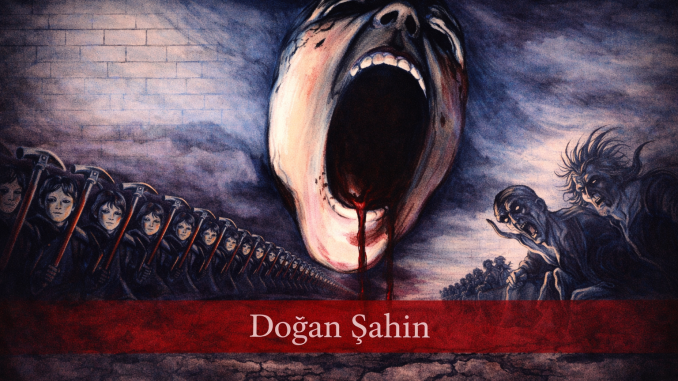
THE WALL
Doğan Şahin
Introduction
When I first watched this film, I thought it was a powerful work of social criticism. When I watched it again thirty years later, I came to think of it as a film that turns one person’s psychological troubles into a social critique through a highly successful act of externalization.
The first time I saw it, I thought it was a film criticizing war and the system that leads to it, through the drama of an orphaned child whose father was killed in war. The second time, I also saw that it was the story of a child who, having lost his father, could not separate from his mother in a healthy way and therefore could not individuate.
Two things affect a person’s personality more than anything else. The first, and more important one, is close relationships and family dynamics; the second is society. Yet society, at least until the child becomes socialized, usually does not act directly; it exerts its influence by affecting the parents. In this film, the effects of both are conveyed quite well. When I first watched it, perhaps because I looked at life in more political terms in those years, what caught my attention more were the social and political factors. War was such a powerful and destructive force that I could not clearly see the individual story beneath its impact. This time, I will deliberately do the opposite and focus more on the individual story and the psychological factors.
Goodbye Blue Sky
Pink’s story, just like Roger Waters’s, begins with the loss of his father in the war in 1944. Pink was only a five-month-old baby then. The loss of his father becomes the fundamental event that darkens his life and his sky, and gives the song its name as well. The film begins with this song (“Goodbye Blue Sky”) and with Pink losing his father. Then, parallel to the war scenes, we see police violence during student protests. In this way, those in power appear as the forces that darken our sky and drown the world in violence and evil.
The Little Boy to Whom Santa Claus Brings No Gifts
Being the child to whom Santa Claus brings no gifts also means being fatherless. It signifies deprivation of the joy, blessings, and protection the father would have brought, and also exclusion from being a harmonious part of society. Yet at the same time, becoming aware of this deprivation and the exclusion it creates carries a potential for enlightenment. Realizing that Santa Claus does not exist reveals the difference created by thinking differently from others, by no longer sharing the same fairy tale with them.
Within Pink’s story, not receiving gifts at Christmas may perhaps also be interpreted as an original variation on Christ: one who is deprived of his father’s protection, is symbolically killed, and through that gains individuality and is reborn. Yet I do not think the screenwriter or director consciously intended such an interpretation. It may have emerged as unconscious material seeping into the film without their awareness.
Poems! Everybody
Pink’s first attempt at rebellion appears when he and his friends explode the bullets left by his father on the railway tracks. We may say that the train and the railways used in this scene symbolically represent the existing order, its functioning, and its power. The bullets, meanwhile, seem like a way of opposing the existing order with its own tools. Education, which is both an instrument and another form of that order, is portrayed as an institution in which children are put through a mould, their uniqueness destroyed, and their interests and enthusiasms mocked and eliminated as though they were weaknesses. It is presented as one of the walls enclosing everyone, including the teachers.
The main questions I mentioned above regarding the film also apply to this section. Does the violence manifested both in the symbolic bombing of the railway tracks and in the destruction of the school arise from Pink’s own deprivation, resentment, and anger, or is it a political solution proposed by the director?
A society with no education at all would possess a culture barely above that of animals. Many things in the film, I think, are treated in an “all or nothing” way and pushed to extremes, perhaps because of both Pink’s psychological structure and that of the director. Rather than asking that cultural, artistic, and scientific knowledge—which enriches human beings—be transmitted to new generations in ways that do not damage their uniqueness and freedom, calling for the abolition of education altogether may be read as part of the “childlike” rebellion of the seventies. But it may also be a product of the same tendency, visible elsewhere in Pink, to split things wholesale into all good or all bad. When I watched it thirty years ago, the dimension of social rebellion seemed more dominant to me. Now it looks more like a natural consequence of Pink’s fragmented inner world.
Mother, Will They Like the Song?
Mother do you think they’ll like this song?
Mother do you think they’ll try to break my balls?
Mother should I build the wall?
Mother should I run for president?
Mother should I trust the government?
Mother will they put me in the firing line?
Ooh ah, is it just a waste of time?
Hush now baby, baby, don’t you cry.
Mama’s gonna make all of your nightmares come true.
*Mama’s gonna put all of her fears into….
Pink’s inner world and dynamics are summarized extremely well in this song. Although I do not fully embrace Masterson’s theory of abandonment depression as a general framework for explaining borderline states and narcissistic pathology, I do find it highly useful in explaining certain cases. In fact, this theory of abandonment depression—which I do not otherwise adopt wholeheartedly—strikes me as the approach that best fits the story of the film’s protagonist and explains him most clearly.
Masterson and Abandonment Depression
According to Masterson, a mother who herself probably has borderline or narcissistic features prevents the child from separating from her, individuating, and thus developing a real self.
The mother’s basic mechanism here is the threat of abandonment. Perceiving that, if he individuates, he will lose his mother’s love and fall into the painful experience of abandonment depression, the child develops a false self under this overwhelming threat.
Masterson sees the separation-individuation phase as the stage in which the real self is acquired. When the mother blocks the child’s growing independence and individuation by threatening loneliness, the development of the real self comes to a halt. This arrest then leads to borderline pathology, or to a narcissistic trajectory, in other words, to the false self. In the typical family structure that gives rise to borderline pathology, the mother, on the condition that she takes possession of the child, tolerates—or even encourages—the father’s withdrawal from the family. Thus the child loses his second chance to separate from the mother. Or, as in the film, there is no father at all. The child has never had a second chance to move away from the mother.
On the one hand, he experiences anxieties about being defeated, swallowed up, within his mother’s orbit; on the other, he constantly needs her emotional support. Independence therefore becomes a deeply conflicted process.
Pink’s father’s early death causes the mental representation of the father to take an excessively idealized form rather than a realistic one. An excessively idealized father—one who can never be reached or surpassed—may become, for the boy, a kind of Sword of Damocles that continually feeds and reminds him of his inadequacy.
The mothers of borderline patients, because they wish to maintain a symbiotic relationship with their children, prevent them from preserving emotional balance as independent beings separate from themselves. The obstacle facing the child on the path toward individuation and autonomy is the mother’s withdrawal of emotional support, threatening him with loneliness and abandonment. Most likely, because of her own separation anxieties, the mother feels anger toward the child and displays passive-aggressive attitudes.
In the face of feelings of abandonment and loneliness, the child develops defenses such as avoiding stimuli toward individuation, denial, and, pervasively, splitting. While feelings of abandonment are warded off through various defenses, the most important result is that the separation-individuation phase comes to a halt and autonomy is never attained.
According to Masterson, the mother’s withdrawal of support in response to her child’s attempts at individuation reinforces the child’s primitive aggression. As a result, positive and negative self and object representations are prevented from developing into whole object relations. The object relations world becomes split into two units: one rewarding (good), the other withdrawing (bad).
According to Masterson, when the supportive and rewarding part-object relationship is activated, the pathological pleasure self comes into play; in that state, passivity and self-destructive behaviors dominate the picture. When the withdrawing, disapproving unit dominates the transference, feelings of abandonment emerge. This is then followed, as a defense, by the reactivation of the rewarding relationship.
Bowlby showed that abandonment depression in early childhood (between 13 and 32 months) unfolds in three stages:
a) protest and longing for reunion
b) despair
c) emotional detachment and distancing
The stage of protest and longing for reunion may last from several hours to several weeks. The child tries to use every means available to regain the mother, expects her to return, and rejects alternative figures offered in her place. In the despair stage, the child appears depressed and inactive. He cries monotonously or intermittently, makes no demands, ceases activity, and withdraws into himself. In the stage of emotional detachment from the mother, he begins once again to turn toward the environment. He no longer rejects the nurses, and accepts their care, their food, and their toys. When his mother comes to visit, he is indifferent to her and may have difficulty recognizing her. The longer the hospital stay lasts, the more the child attaches himself successively to nurses who also leave him, and these experiences repeatedly recreate the original abandonment. Gradually he becomes indifferent to the people around him; he can no longer risk attachment and abandonment. He becomes excessively self-centered and turns more toward objects and food than toward people. He shows no particular joy on the visiting days of his mother and father.
According to Masterson, the reactions of borderline patients to abandonment also resemble this second phase: abandonment depression. Depending on the patient’s developmental characteristics, this depression has six components, with one or another coming to the forefront at different times. Masterson calls them the six horsemen of the psychic apocalypse: depression, panic, rage, guilt, helplessness, and emptiness.
Dimmed False Self
A person who cannot realize his true self avoids maturing in order to feel safe. He externalizes his problems; instead of accepting his unhappiness, failures, and inhibitions as part of life that he himself must bear, he projects them onto his mother. He is extremely sensitive to rejection and exclusion. Acting out is generally directed toward self-destruction; in the struggle against feelings of abandonment, alcohol, drugs, excessive work, and similar methods come into play.
Because the mechanism of splitting violently alters his relationship to himself and to others, activating primitive part-object relations colored by primitive emotional tones, he cannot maintain attachment when frustrated or enraged. The self-image in this state is that of someone clingy, passive, and unable to assert himself. The bad self-image, by contrast, desires to be active and independent. Parallel to the good self-image, the good object also supports dependency, weakness, and clinging.
Throughout the film, Pink cyclically shifts from a passive, uninitiating, almost severed and weak state of self to another state of self that is active, aggressive, and strong. For example, while he is completely passive and anxious in the face of the girl trying to seduce him, he later turns into a frightening, active, and violent figure himself. At another moment, while he is a passive child submitting to the humiliations of the teacher, he transforms into a perpetrator of violence who destroys the teacher and the whole system.
Throughout his life, the passive, submissive, yielding self-state he has often experienced is repeatedly followed by another self-state that is active and powerful. The most extreme example is when he turns into a Nazi leader. He is finally freed from all his fears and passivity—but only by becoming a tyrant.
Father, Masculinity, Identification, and Castration
The loss of important objects gives rise to large-scale identifications. Pink’s attempts throughout the film to inflict moral and physical pain on himself and to destroy himself may be an expression of identification with the dead father, of a wish to become him by dying like him. At the same time, this may also be a form of aggression turned against the self, and a kind of self-castration that allows him to sustain the relationship with the mother without turning it into an Oedipal crime in the father’s absence.
Pink’s repeated acts of shaving himself to the point of bleeding, cutting his eyebrows and body hair, are, on the one hand, as noted above, an expression of aggression directed at himself; on the other, they are also a symbolic expression of the refusal of masculinity—that is, of castration. Indeed, once he has stripped himself of all hair, he no longer enters society in a crushed, passive, and weak manner; rather, because there is now nothing left to fear, he appears bold and commanding. Now that he is castrated, he is free of the burden of Oedipal guilt and no longer fears acting “like a man.” As the leader of a great wave of terror, he destroys all the despised and humiliated others—homosexuals, Black people, Jews—who represent the unwanted parts of his own self.
Skin
Skin is both a means of contact with others and a wall that separates us from them. It defines the boundaries of the ego and distinguishes us from others, but at the same time it allows us to establish contact with them through touch. Pink’s rage especially toward his own skin may arise because it becomes the object of his conflict between the fear of being swallowed up, the wish for isolation, and the wish to merge with others.
He takes out his anger on his skin and his body, because they keep him from the peace of his solitude by arousing desires for contact with others, while at the same time preventing his wish to merge with others by drawing a wall between him and them.
The Trial: Was I Guilty All My Life?
Despite all its humiliating attitudes and violence, the trial scene contains a hope for Pink’s establishing a relationship and making peace with the order, with those who have hurt him, and with everyone else. The tendency, so prevalent throughout the film, to externalize and project his problems is reversed; this time aggression is directed back at himself, as though all blame and guilt belonged to him. His crime is to have built a wall between himself and others, and between himself and the whole world. By means of this wall, he seems to have prevented people who loved him from reaching him and eliminated the possibility of adaptation and connection.
This final scene may be seen as an expression of an effort to integrate inside and outside, self and other, good object and bad object—and therefore as an expression of hope. Yet because this integration cannot be achieved gradually and gently, it appears instead in the form of a kind of big bang, a total destruction in order to start over again.
Because the film is built on transitions between the individual story and the social sphere, it also has a “revolutionary” and “romantic” ending in the sense that it suggests tearing everything down and rebuilding it anew for the sake of social healing as well.
Still, the child gathering up the bricks in the final scene remains ambiguous: does he represent, as in the endings of horror films, a new “creature” who will build himself another wall out of those bricks? Or does he represent the hope of building a new world from them?
It is left unresolved.
Bir yanıt bırakın